
Hijama UAE

SUNNAH HIJAMA POINTS

Hijama Sunnah Points: Cupping Locations Mentioned in Hadith

Sunnah Hijama points are body locations where cupping was reported from the Prophet Muhammad ﷺ in Hadith literature. Not all locations shown on modern Hijama charts are established as Sunnah points, and the strength and context of the narrations differ between locations.

Hijama Knowledge Center with cupping therapy points and educational guides

In short:

The best-attested Hijama locations include Al-Akhda‘ayn, Al-Kahil and cupping on the head. Other locations, such as the hip and dorsum of the foot, are also reported in narrations but were associated with specific pain or injury rather than described as universal Hijama points.

Download

Hijama Sunnah Points PDF

Download the Hijama Sunnah Points PDF, a concise visual guide to the main cupping locations mentioned in Hadith, including Al-Kahil, Al-Akhda‘ayn and reported head-cupping locations.

Download Hijama Sunnah Points PDF →
i
The PDF uses modern chart numbers only as visual references. The Hadith identifies anatomical locations by name, not by numbered points.
Main Sunnah Hijama Points
1
Al-Akhda‘ayn Two sides of the upper neck.
2
Al-Kahil Upper central back region.
3
Head Cupping Reported in authentic Hadith.
Other Reported Locations
•
Hip Region Reported in a specific clinical context.
•
Dorsum of the Foot Reported in relation to pain or injury.
HIJAMA UAE
Hijama
Sunnah Points
A Visual Guide Based on Hadith
Dr Amr Salama
Physiotherapist & Hijama Practitioner

What Are Sunnah Hijama Points?

Sunnah Hijama points are locations on the body where cupping is reported to have been performed on the Prophet Muhammad ﷺ in Hadith sources.
However, the term should be used carefully. The Hadith literature generally describes anatomical locations rather than the numbered point systems commonly found on modern Hijama charts.

For example, terms such as Al-Akhda‘ayn and Al-Kahil come from the narrations themselves, while numbers such as Point 1, Point 2 or Point 32 are modern chart labels used to help identify approximate anatomical locations.

Key Point

Modern point numbers can help locate a Sunnah-related area, but the numbering itself is not part of the Sunnah or the Hadith.

Which Hijama Points Are Well Attested?

Several cupping locations are reported in Hadith sources. The clearest evidence relates to Al-Akhda‘ayn, Al-Kahil and cupping on the head. These locations should be distinguished from modern numbered Hijama charts.

01
Al-Akhda‘ayn — The Two Sides of the Neck

Cupping at Al-Akhda‘ayn is specifically reported from the Prophet ﷺ together with Al-Kahil.

Reported in Jami‘ al-Tirmidhi 2051 and other Hadith collections.
02
Al-Kahil — Upper Back Region

Al-Kahil is mentioned alongside Al-Akhda‘ayn and generally refers to the upper back region around the base of the neck and between the shoulders.

Reported in Jami‘ al-Tirmidhi 2051, Sunan Abi Dawud and Sunan Ibn Majah.
03
Head Cupping

Authentic reports establish that the Prophet ﷺ underwent cupping on the head, including for headache while in Ihram.

Sahih al-Bukhari 5701; also reported in other collections.
Important distinction: The general practice of head cupping is strongly established. The specific name Umm Mughith is also reported in Hadith literature, but scholars have differed over the grading of some of its chains. For this reason, it is better discussed separately from the more firmly established general evidence for cupping on the head.

Al-Akhda‘ayn — The Two Sides of the Neck

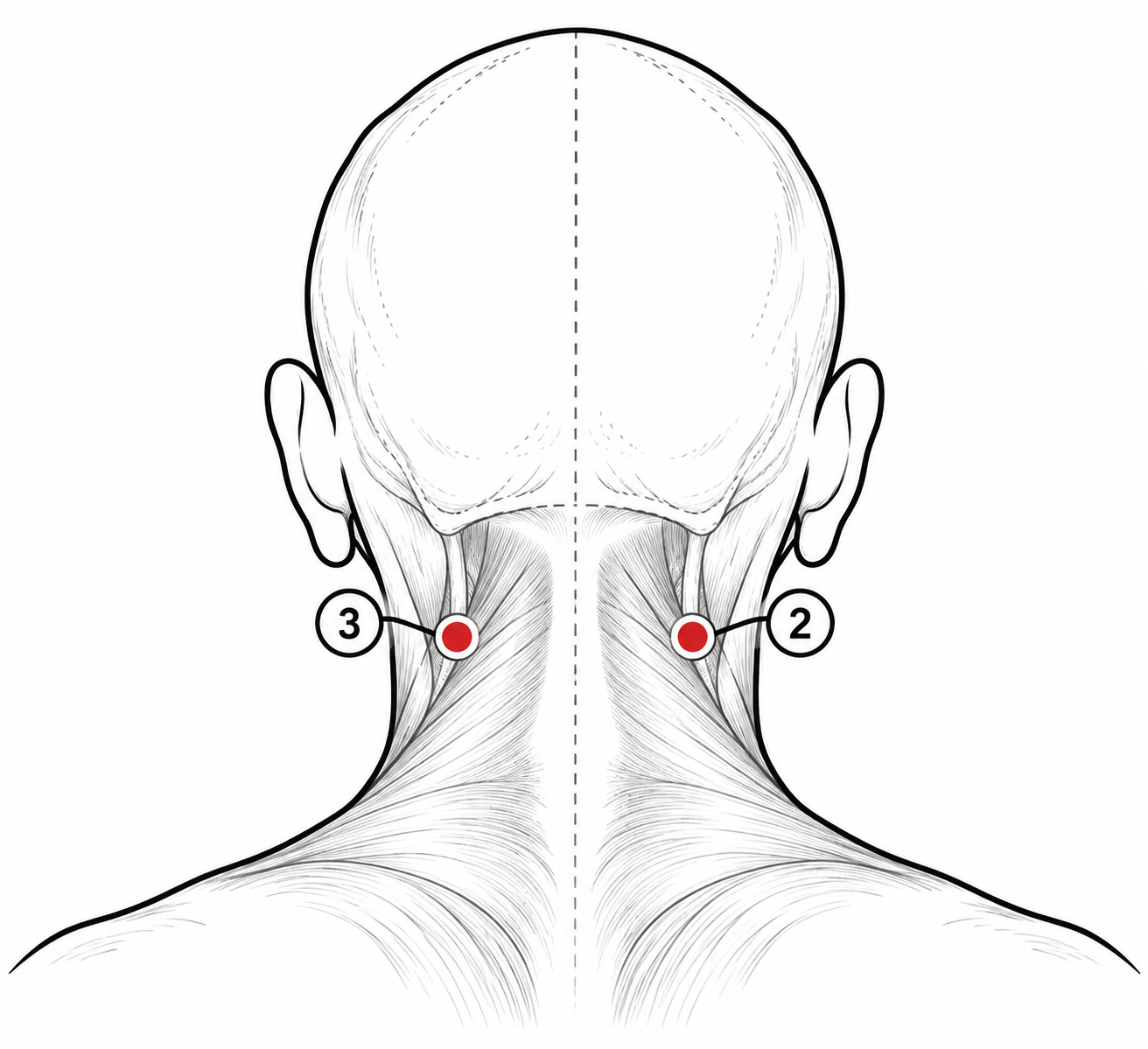
Al-Akhdaayn Sunnah Hijama points on both sides of the upper neck, shown as points 2 and 3

Al-Akhda‘ayn — Points 2 & 3

Al-Akhda‘ayn refers to two locations on the right and left sides of the neck. They are among the clearest cupping locations specifically reported from the Prophet Muhammad ﷺ.

In modern Hijama charts, the approximate bilateral locations may be represented as Points 2 and 3. These numbers are used only as modern reference labels and are not part of the Hadith itself.
Location
Bilateral upper-neck region, one location on each side.
Hadith Term
Al-Akhda‘ayn (الأخدعان)
Chart Reference
Points 2 and 3 in the Hijama chart used in this atlas.
Evidence
Reported together with Al-Kahil in Jami‘ al-Tirmidhi 2051, Sunan Abi Dawud 3860 and other Hadith collections.
Hadith Evidence: Anas ibn Malik reported that the Prophet ﷺ used to undergo cupping at Al-Akhda‘ayn and Al-Kahil. The narration in Jami‘ al-Tirmidhi 2051 was graded Hasan Gharib by al-Tirmidhi.
Atlas Note: Points 2 and 3 are modern chart references used to illustrate the approximate area. The Hadith identifies Al-Akhda‘ayn by anatomical name rather than by point numbers.

Al-Kahil — Upper Back Region

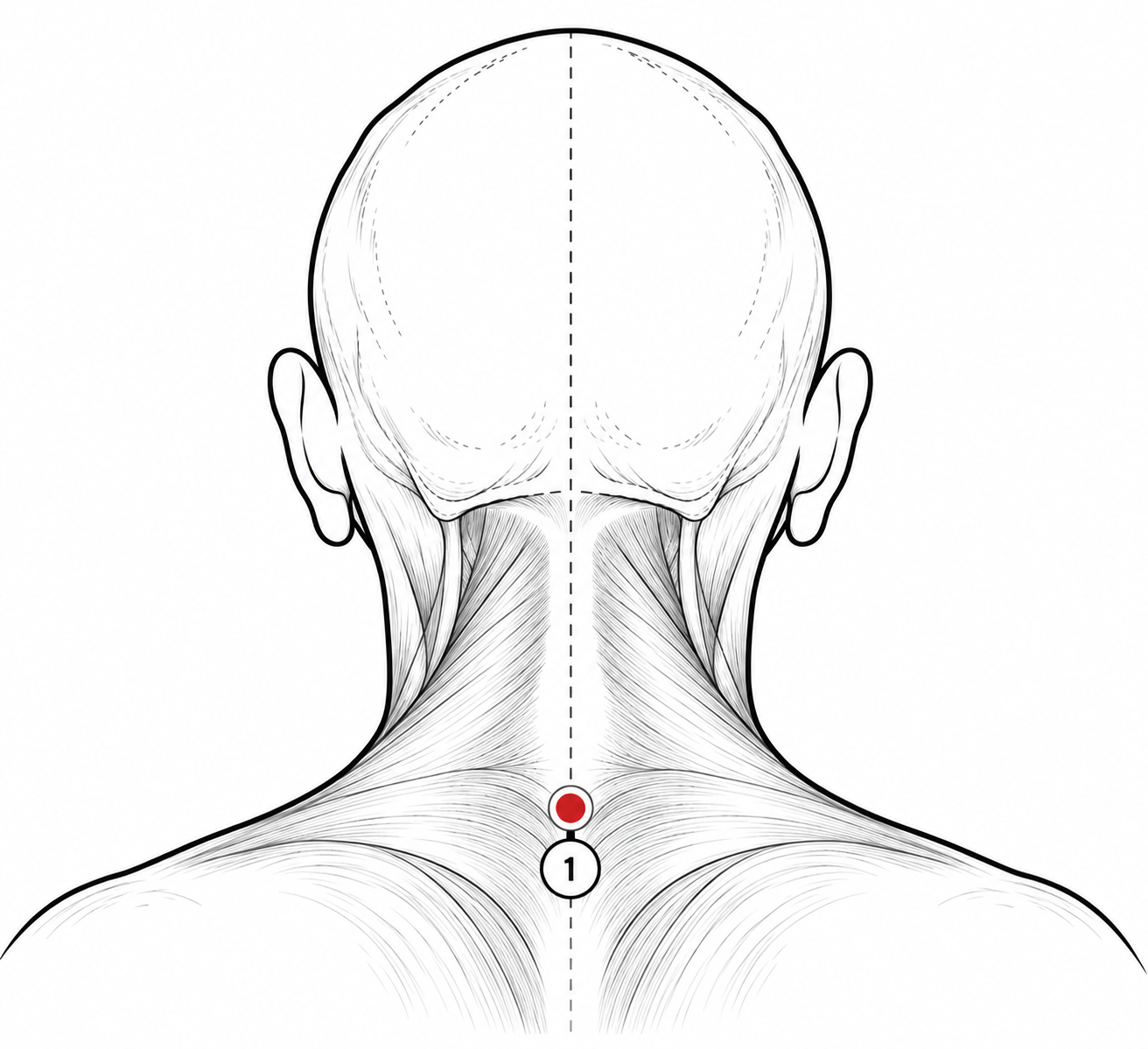
Al-Kahil Sunnah Hijama location shown as Point 1 on the upper back

Al-Kahil — Point 1

Al-Kahil is an upper-back Hijama location around the base of the neck and upper central back. It is one of the best-known cupping locations reported from the Prophet Muhammad ﷺ.

In the Hijama atlas used on this website, the approximate location is represented as Point 1. The number is a modern chart reference and is not part of the Hadith itself.
Location
Upper central back near the base of the neck and between the shoulders.
Hadith Term
Al-Kahil (الكاهل)
Chart Reference
Point 1 in the Hijama atlas used on this website.
Evidence
Reported together with Al-Akhda‘ayn in Hadith collections including Jami‘ al-Tirmidhi.
Hadith Evidence: Anas ibn Malik reported that the Prophet ﷺ underwent cupping at Al-Akhda‘ayn and Al-Kahil. This supports Al-Kahil as a reported Prophetic cupping location.
Atlas Note: Point 1 is a modern reference used to illustrate the approximate anatomical area of Al-Kahil. The Hadith describes the location by name, not by a numbered point.

Head Cupping and Umm Mughith

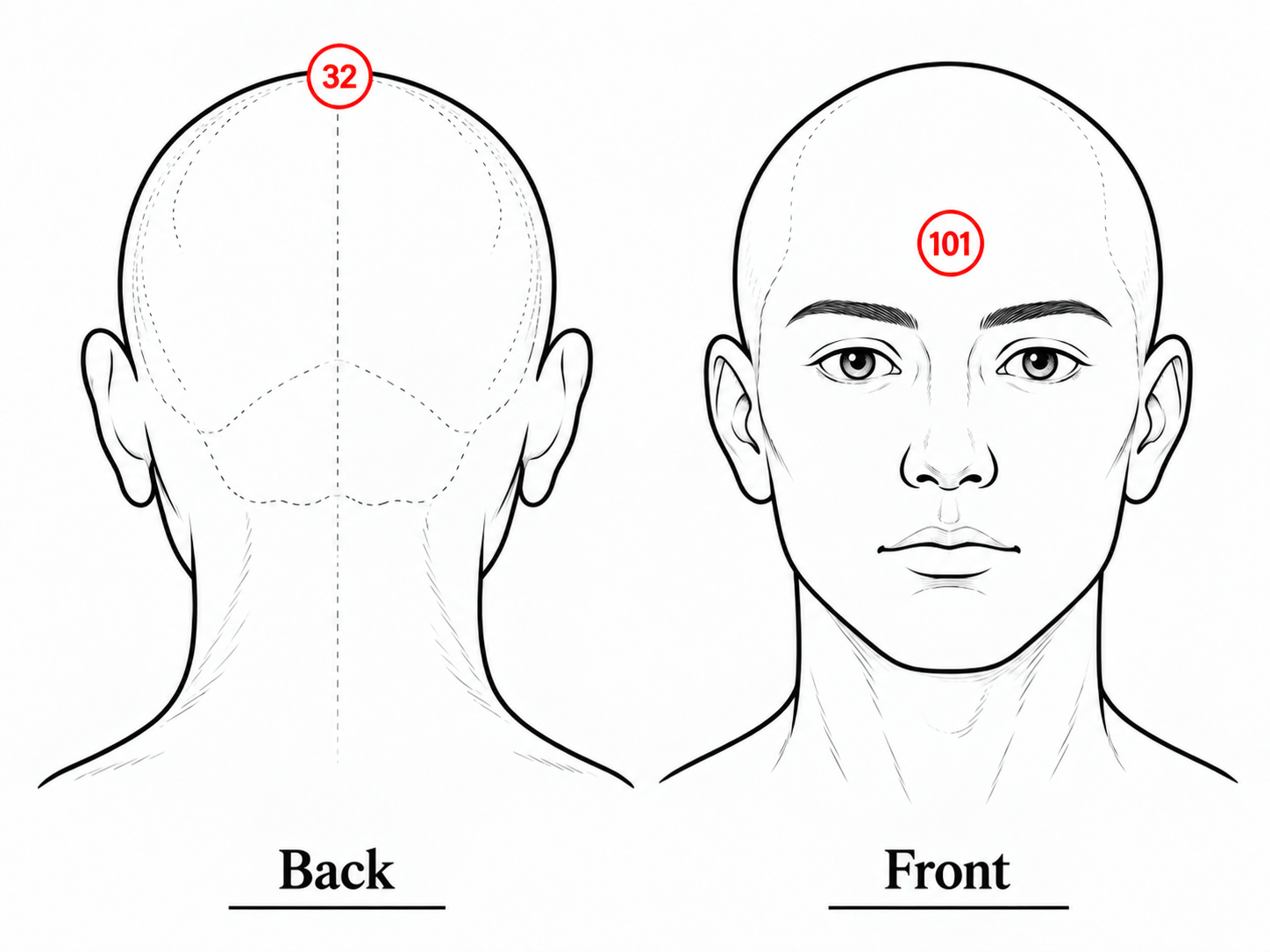
Head Hijama chart showing Point 32 on the top of the head and Point 101 on the central forehead

Head Cupping — Points 32 & 101

Cupping on the head is reported in authentic Hadith sources. Modern Hijama charts may use numbered locations to help identify different areas of the scalp and forehead.

In the atlas used on this website, Points 32 and 101 represent two commonly referenced head locations. These numbers are modern chart labels and are not themselves part of the Hadith.
32
Top of the Head Located around the central upper part of the head or crown region. This area is commonly identified in traditional Hijama charts as a central head-cupping location.
101
Central Forehead Region Located on the frontal midline of the forehead. Point 101 is a traditional chart reference used to identify this anterior head location.
Hadith Evidence: Authentic narrations establish that the Prophet Muhammad ﷺ underwent cupping on the head. These reports support head cupping as a Prophetic practice, but they should not automatically be interpreted as validating every numbered location used in modern Hijama charts.
Atlas Note: Points 32 and 101 are modern reference numbers used in the Hijama atlas. The Hadith literature describes anatomical locations and circumstances of cupping rather than this modern numbering system.
Safety Note: Head and forehead cupping require careful anatomical assessment. The presence of a location on a traditional chart does not mean that it is appropriate for every person or clinical situation.

Other Reported Cupping Locations

Other cupping locations are also reported in Hadith literature. However, some of these reports describe cupping for a particular pain, injury or circumstance rather than presenting the location as a routine Sunnah point for everyone.

Reported Location

Hip Region — Al-Warik

Cupping on the hip region is reported in Hadith literature in relation to pain or discomfort affecting that area.

Location The hip or lateral pelvic region.
Arabic Term Al-Warik (الورك)
Context Reported in association with a specific painful condition rather than as a universal cupping location.
Evidence Note: The narration supports the hip as a reported cupping location in a specific clinical context. It should not automatically be interpreted as a recommended routine point for every person.
Reported Location

Dorsum of the Foot

Cupping on the upper surface of the foot is also reported in Hadith literature in connection with pain or injury affecting the foot.

Location The dorsum, or upper surface, of the foot.
Context Reported for a particular painful condition rather than as a general Sunnah point for routine use.
Chart Use Modern Hijama charts may assign a numbered point to this area, but the numbering is not part of the Hadith.
Evidence Note: Reports concerning cupping on the foot should be understood within their original context. They do not establish that this location treats every condition or should be used routinely.
Important distinction: A location being mentioned in a Hadith does not necessarily mean that it was intended as a universal Sunnah point for all people and all conditions. Some locations were used because of a specific complaint, injury or circumstance at the time.

Traditional Point Numbers vs Hadith Locations

Hadith narrations describe Hijama locations using anatomical names and body regions rather than the numbered point systems commonly used in modern Hijama charts.

Numbers such as Point 1, Point 2, Point 3, Point 32 or Point 101 are modern reference labels used to make charting and anatomical identification easier. The numbers themselves are not part of the Sunnah or the Hadith.

Hadith Location
Modern Chart Reference
Interpretation
Al-Kahil
Point 1
Approximate upper-back location near the base of the neck.
Al-Akhda‘ayn
Points 2 & 3
Approximate bilateral upper-neck locations used in the atlas.
Head Cupping
Points 32 & 101
Modern chart references for commonly used head and forehead locations. The Hadith does not identify these locations by number.
Key Point: The Sunnah identifies cupping locations by anatomical description. Modern Hijama charts add point numbers only as a practical reference system for teaching, charting and locating approximate areas.
Important: Mapping a modern numbered point to a Hadith location is an anatomical interpretation. It should not be presented as though the point number itself appears in the original narration.

Do Sunnah Points Treat Specific Diseases?

The fact that a Hijama location is reported in the Sunnah does not mean that it is a proven treatment for every disease or symptom.

Hadith reports establish that cupping was practised at particular body locations, but they do not provide a modern disease-by-disease treatment map. Claims that a specific Sunnah point cures a particular condition should therefore be separated from the historical evidence that the location itself was used.

Sunnah Evidence Establishes that cupping was reported at a particular anatomical location.
Clinical Evidence Is needed separately to evaluate whether cupping may help a specific medical condition.
Traditional Associations May link certain points with organs or symptoms, but these associations are not automatically established by Hadith.
Individual Assessment Point selection should also consider anatomy, symptoms, health status and safety.
Key Point: A point can be authentically reported as a Prophetic cupping location without that automatically proving that the same point treats a specific disease.

Safety and Clinical Considerations

A Hijama location being reported in Hadith does not mean that it is automatically suitable for every person or every clinical situation.

Point selection should still consider anatomy, skin condition, blood vessels, nerves, current symptoms, medical history and the type of cupping being performed.

Particular care is needed when cupping around the neck, head or other sensitive anatomical regions. Modern practice should combine respect for the reported Sunnah locations with appropriate clinical assessment and infection-control standards.

Safety Note

Sunnah-related locations should not be used mechanically from a chart. Anatomical safety and individual assessment should always come first.

Read the full Hijama Safety & Contraindications guide →

Summary

Sunnah Hijama points are anatomical locations where cupping was reported from the Prophet Muhammad ﷺ in Hadith sources.

The clearest reported locations include Al-Akhda‘ayn, Al-Kahil and cupping on the head. Other locations, such as the hip and dorsum of the foot, are also reported but often in the context of a specific complaint or circumstance.

Modern point numbers such as 1, 2, 3, 32 and 101 are practical chart references only. They are not part of the original Hadith terminology.

A reported Sunnah location should also not be interpreted as proof that the point treats a particular disease. Safe practice still requires anatomical knowledge, clinical assessment and appropriate infection-control procedures.

SCIENTIFIC REFERENCES

References

01

Jami‘ at-Tirmidhi 2051.

Reports that the Prophet Muhammad ﷺ underwent cupping at Al-Akhda‘ayn and Al-Kahil. Al-Tirmidhi described the narration as Hasan Sahih; later grading assessments may differ.

02

Sunan Abi Dawud 3860.

Reports cupping at the two sides of the neck, Al-Kahil, and also mentions cupping on the top of the head. The narration is graded Sahih by Al-Albani in the referenced edition.

03

Sahih al-Bukhari 5700–5701.

  • Reports that the Prophet ﷺ was cupped on the head while in Ihram because of pain or headache. Sunnah.com

04

Sunan Abi Dawud 3863.

Reports that the Prophet ﷺ was cupped on the hip region because of a contusion or injury affecting that area. Sunnah.com

05

Sunan Abi Dawud 1837.

Reports cupping on the dorsum of the foot because of pain while in Ihram. The referenced edition grades the report Sahih, while Abu Dawud also records discussion regarding one route of transmission.

screenshot 2026 10 01 160747

Written by

Dr Amr Salama, DPT

DPT, Cairo University • Licensed Physiotherapist in Dubai • MOHAP-Licensed Hijama Practitioner

Dr Amr Salama writes and reviews evidence-informed educational content on Hijama, cupping therapy, rehabilitation and related health topics.

Last reviewed
October 2026

EXPLORE MORE

Related Hijama Guides

Sunnah Hijama

Learn about Hijama in the Sunnah and the Hadith evidence behind the practice.

READ GUIDE →

Hijama Safety & Contraindications

Understand when Hijama may require extra caution or may not be suitable.

READ GUIDE →

Hijama Sunnah Days

Explore the days traditionally associated with Hijama in Hadith sources.

READ GUIDE →

Hijama Points Atlas

Explore common Hijama body points and anatomical cupping locations.

READ GUIDE →