
Hijama UAE

HIJAMA POINTS & ATLAS

Hijama Points Atlas: Body Points, Chart and Cupping Areas

Hijama points refer to specific areas of the body where cups may be applied according to treatment goals, traditional practice and individual assessment. This atlas provides a clear visual guide to common Hijama points, body regions and cupping areas, while distinguishing traditional point systems from evidence-based clinical use.

Hijama Knowledge Center with cupping therapy points and educational guides
Hijama Points Resources

Explore and Download Hijama Point Guides

Use the Hijama Points Atlas for body maps and anatomical references, or explore the separate Sunnah Hijama Points guide for cupping locations reported in Hadith.

In short:

There is no single universal Hijama point map suitable for every person or condition. Point selection depends on the treatment goal, anatomy, individual assessment and whether the point comes from traditional practice, Sunnah-related sources or modern clinical use.

What Are Hijama Points?

Hijama points are specific areas of the body where cups may be applied according to the treatment goal, anatomical location, traditional practice and individual assessment.

Unlike a fixed medical map, Hijama point selection can vary between practitioners and treatment approaches. Some points are based on general body regions, some are linked to traditional or Sunnah-related sources, and others may be selected according to modern clinical reasoning.

For this reason, a Hijama point should not automatically be assumed to diagnose or treat a specific disease simply because it appears on a chart.

Key Point

Hijama points are treatment locations, not diagnostic markers. Their selection should depend on the individual and the purpose of treatment.

How Are Hijama Points Selected?

Hijama points should be selected according to the treatment goal, the individual’s symptoms, relevant anatomy and the practitioner’s assessment.

Some points are chosen because they lie over specific muscle groups, areas of tension or regions associated with pain and restricted movement. Other points may come from traditional Hijama practice or Sunnah-related sources.

Point selection should not be based only on a generic chart. The same point may not be appropriate for every person, and treatment location should take into account skin condition, medical history, safety considerations and the type of cupping being used.

Point Selection May Consider: -

  • Treatment goal
  • Individual symptoms
  • Relevant anatomy
  • Muscle tension or painful areas
  • Traditional Hijama practice
  • Sunnah-related sources
  • Skin condition and safety
  • Type of cupping being used

Key Point

A Hijama chart can guide point location, but individual assessment should determine whether a point is appropriate.

Hijama Body Points Atlas

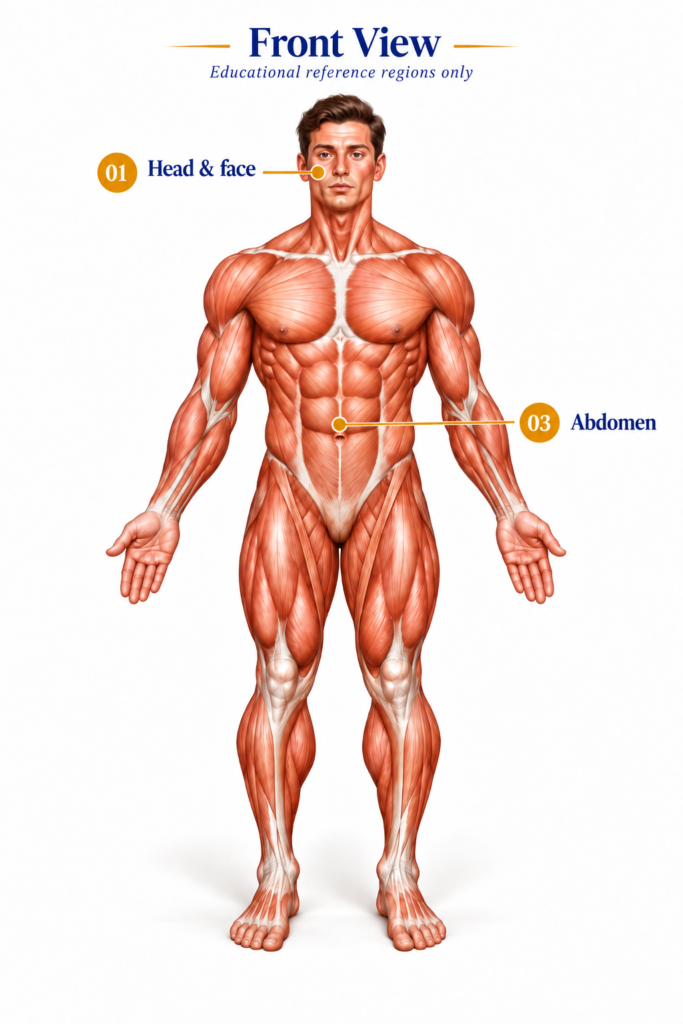
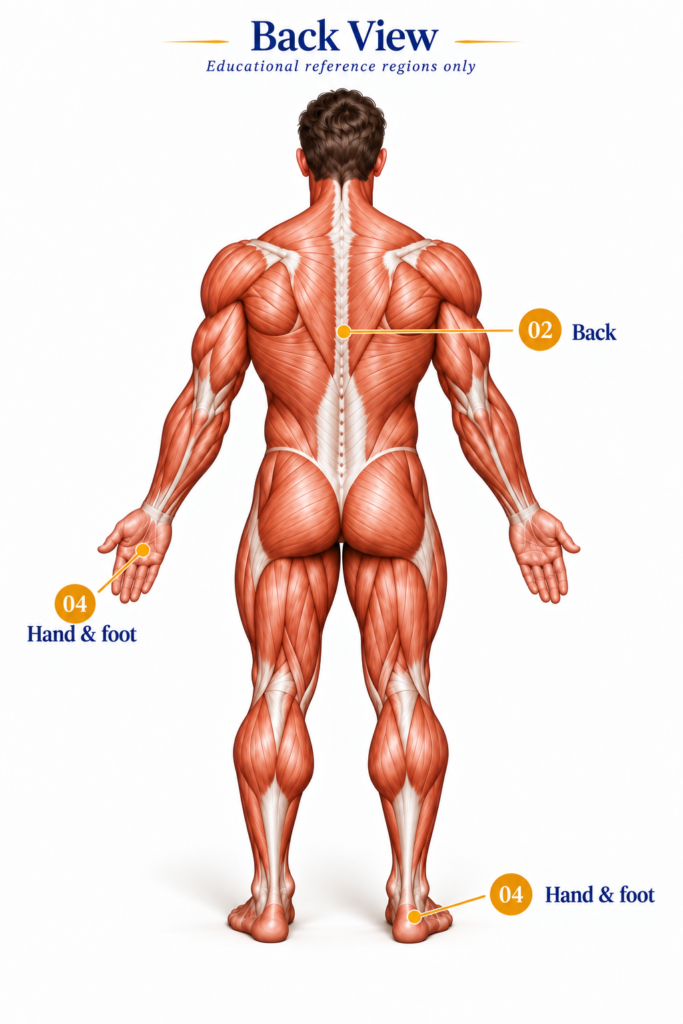
The Hijama Body Points Atlas provides a visual overview of common body regions used for cupping. These locations are educational reference areas and should not be interpreted as fixed treatment prescriptions for every person or condition.

front view muscle anatomy guide
chatgpt image oct 7, 2026, 04 02 24 pm

Explore Hijama Body Regions

Atlas Note

These numbered body regions are educational reference areas only. They should not be interpreted as fixed treatment points or as proof that a particular region treats a specific disease.

Head and Neck Hijama Points

Hijama points around the head and neck may be selected according to the treatment goal, relevant anatomy, traditional practice and individual assessment. The locations shown below are educational reference areas and are not automatically suitable for every person or condition.

Head, face and neck points shown in traditional Hijama charts. Locations are provided for educational reference only.
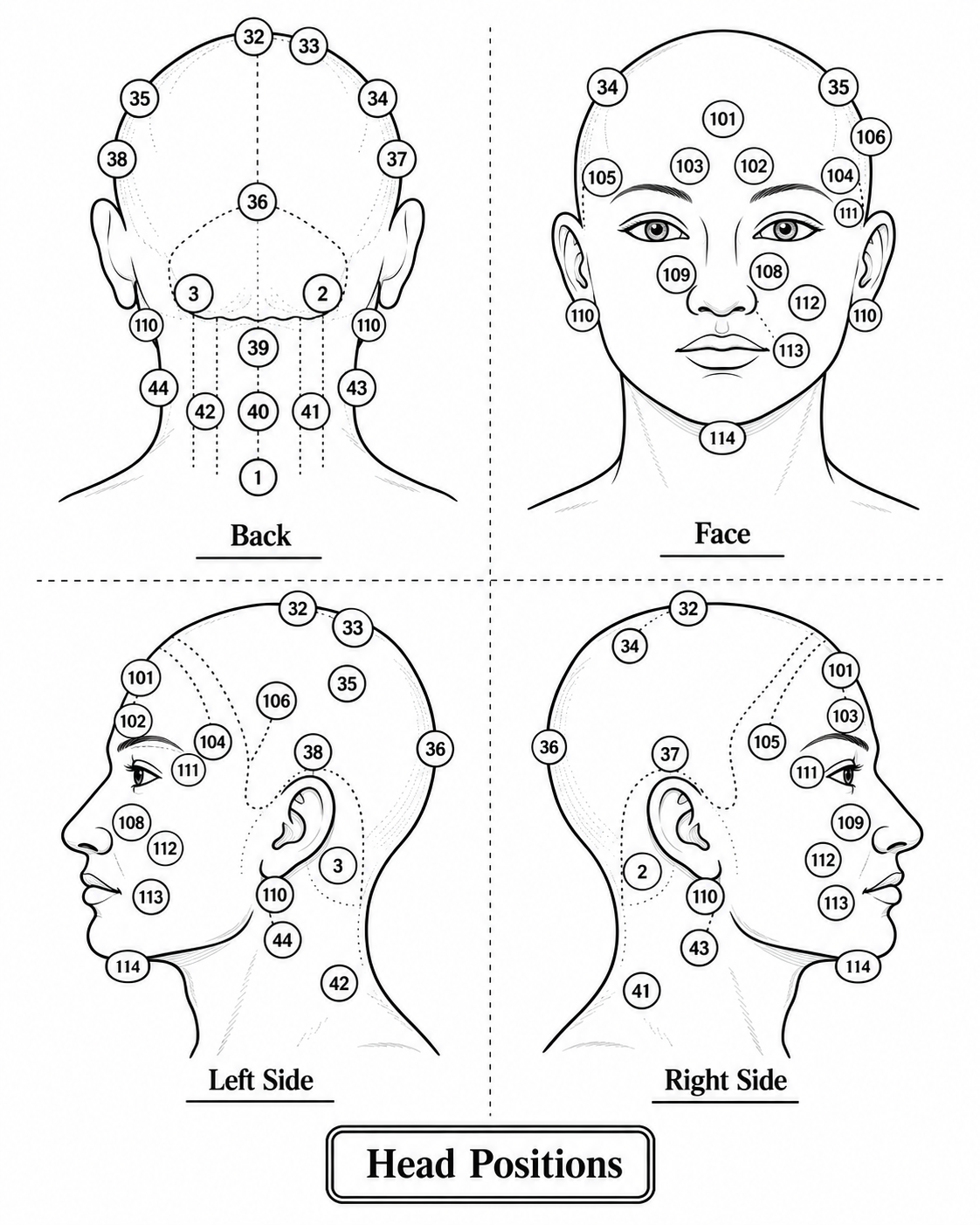
Head face and neck Hijama points chart with numbered traditional cupping locations
2 & 3
Posterior Head / Upper Neck Behind the ears near the lower hairline.
101
Central Forehead Central forehead / prostration area.
102–103
Inner Eyebrow Region Above the inner eyebrows.
104–105
Lateral Brow / Temple Outer eyebrow and temporal region.
106
Upper Temporal Scalp Approximately 6 cm above the ear.
107
Upper Cheek Region Lateral facial region above the cheek.
108–109
Nasal / Cheek Region On both sides of the nose.
110
Below the Ear Near the angle of the jaw.
111–113
Eye, Cheek & Lip Region Around the eye, cheek and mouth.
114
Under the Chin Submental / upper anterior neck region.
32
Top of the Head Near the midline vertex of the scalp.
33
Anterior Hairline Near the front hairline.
34–35
Temporal / Posterolateral Scalp Right and left sides of the scalp.
36
Posterior Midline Head Central occipital region.
37–38
Upper Lateral Scalp Approximately 3 cm above the ears.
39
Occipital Depression Deep posterior occipital region. Caution area in traditional charts.
40
Posterior Midline Neck Middle of the back of the neck.
41–42
Posterolateral Neck Right and left of the posterior midline.
43–44
Lateral Neck Right and left sides of the neck.
Clinical Note: These points are traditional reference locations. Their presence on a chart does not prove that they treat a specific disease. Head and neck cupping requires careful anatomical assessment.

Back and Shoulder Hijama Points

Back and shoulder points shown in traditional Hijama charts. These numbered locations are provided for educational and anatomical reference only.
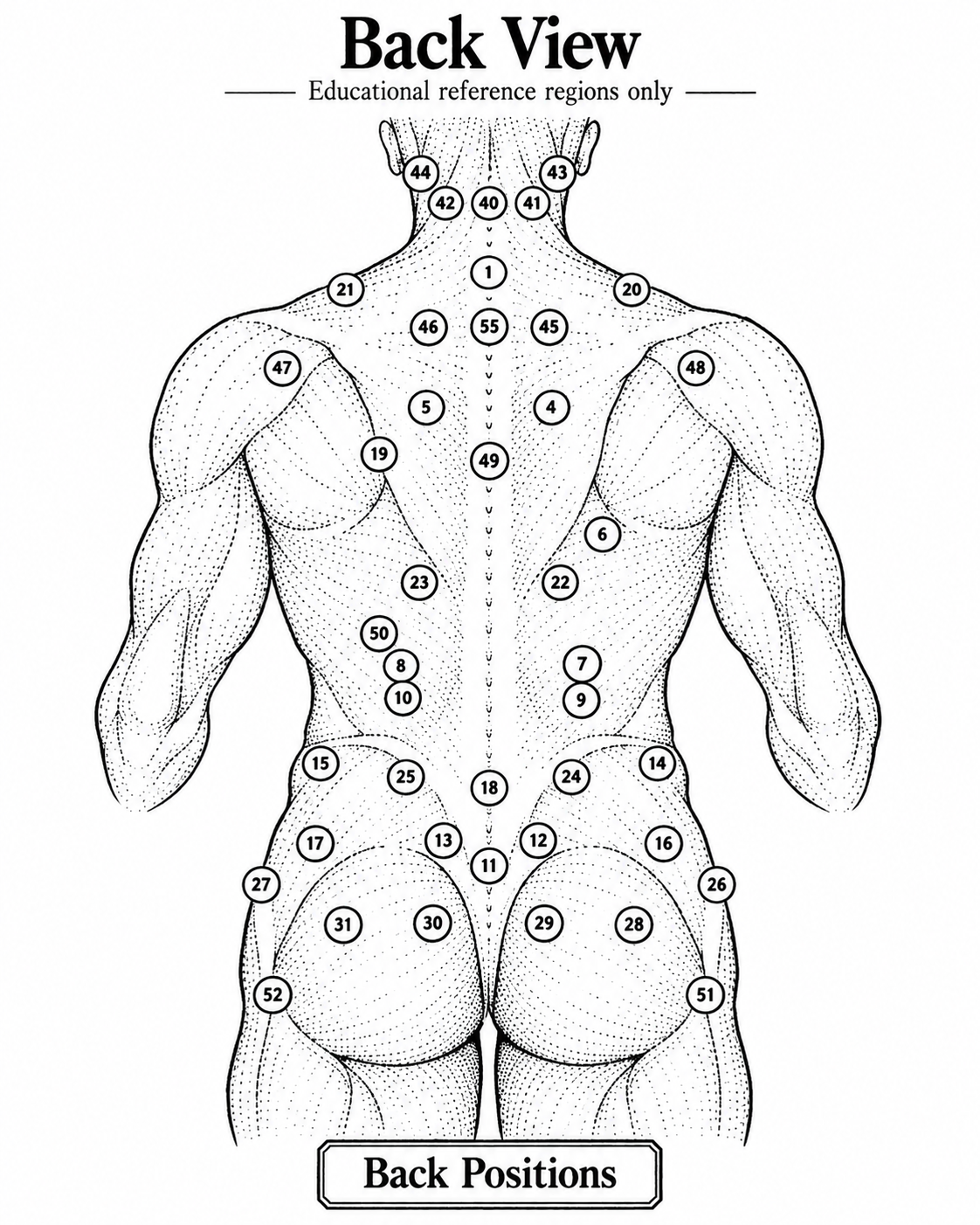
Back and shoulder Hijama points chart with numbered traditional cupping locations
1
Lower Neck / C7 Region Prominent vertebral area at the base of the neck.
20–21
Neck–Shoulder Junction Where the lower neck meets the shoulders.
45–46
Upper Interscapular Region Located above points 4 and 5.
55
Upper Central Back A few centimetres below the lower neck / shoulder region.
4–5
Upper Thoracic Region Located between the shoulder blades. Traditionally associated with respiratory-related complaints.
47
Left Shoulder Region Located over the left upper scapular area. Traditionally associated with the heart region.
48
Right Shoulder Region Located over the right upper posterior rib area. Traditionally associated with the gallbladder region.
49
Central Interscapular Region Located centrally between the shoulder blades. Sometimes described as an “immunity” area in traditional charts.
19
Left Upper Back Located around the left posterior rib and scapular region.
6
Right Mid-Back Region Near the right posterior rib margin toward the spine. Traditionally associated with the gallbladder region.
22–23
Lower Thoracic Region Located beneath the posterior rib margin. Traditionally associated with the pancreatic region.
7–8
Mid-Back Paraspinal Region Located on either side of the spine in the middle back. Traditionally associated with the stomach region.
50
Left Mid-Back Region Located slightly above point 8. Traditional charts associate this location with stomach complaints.
9–10
Lower Mid-Back Region Located below points 7 and 8 on either side of the spine. Traditionally associated with the kidney region.
24–25
Upper Lumbar Region Located around the beginning of the lower half of the back.
14–17
Lower Back / Posterior Flank Located around the lower back and posterior flank areas. Traditional charts associate these sites with regions of the colon.
18
Lower Back Midline Located around the central lower spinal region.
11
Lower Lumbar Midline Located over the lower lumbar region near the spinal midline.
12–13
Lateral Lumbar Region Located on either side of point 11, several centimetres from the spine.
26–27
Iliac / Lateral Pelvic Region Located bilaterally near the outer borders of the iliac bones.
28–31
Upper Gluteal Region Located across the upper part of the buttocks.
Clinical Note: These locations are traditional Hijama reference points. Associations with specific organs or conditions should not be interpreted as proof that cupping at those sites diagnoses or treats the related condition. Point selection should consider anatomy, safety and individual clinical assessment.

Chest and Abdominal Hijama Points

Chest and abdominal points shown in traditional Hijama charts. Locations are provided for educational and anatomical reference only.
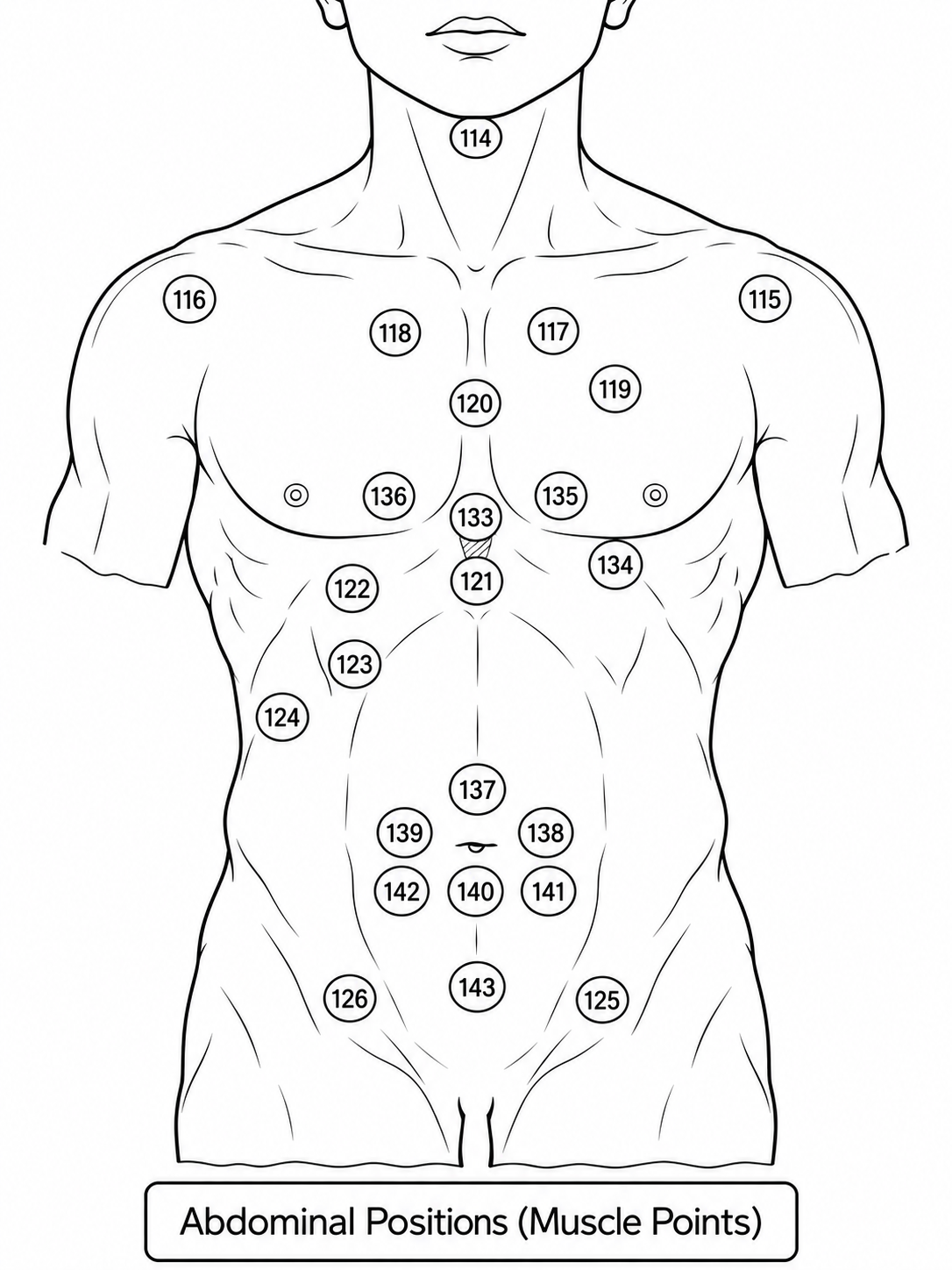
Chest and abdominal Hijama points chart with numbered traditional cupping locations
115–116
Outer Clavicle / Shoulder Region Below the outer ends of the clavicles toward the shoulders.
117–118
Inner Clavicle / Upper Chest Below the inner portions of the clavicles on the upper chest.
119
Left Upper Chest Region Located beneath the middle of the left clavicle. Traditionally associated with the heart region.
120
Sternum / Mid-Chest Located over the sternum in the centre of the chest.
121
Upper Stomach Region Located immediately below the lower end of the sternum.
122–124
Right Upper Abdominal Region Located across the right upper abdomen. Traditionally associated with the liver region.
125–126
Lower Abdomen / Groin Border Between the lower abdomen and upper thigh near the pubic region.
133
Upper Stomach Mouth Region Near the lower end of the sternum above the upper stomach.
134
Left Submammary Region Located beneath the left breast.
135–136
Inner Chest Region Located medially from the nipple region on both sides. Traditionally associated with the lung region.
137–140
Umbilical Region Located above, beside and below the umbilicus.
141–142
Lower Lateral Umbilical Region Located to the right and left of the lower central abdominal area.
143
Suprapubic Region Located in the lower midline abdomen above the bladder region.
Clinical Note: These numbered locations come from traditional Hijama point charts. Associations with specific organs or conditions do not prove that cupping at these sites diagnoses or treats those conditions. Point selection should consider anatomy, safety and individual clinical assessment.

Upper & Lower Limb Hijama Points

Upper and lower limb points shown in traditional Hijama charts. Locations are provided for educational and anatomical reference only.
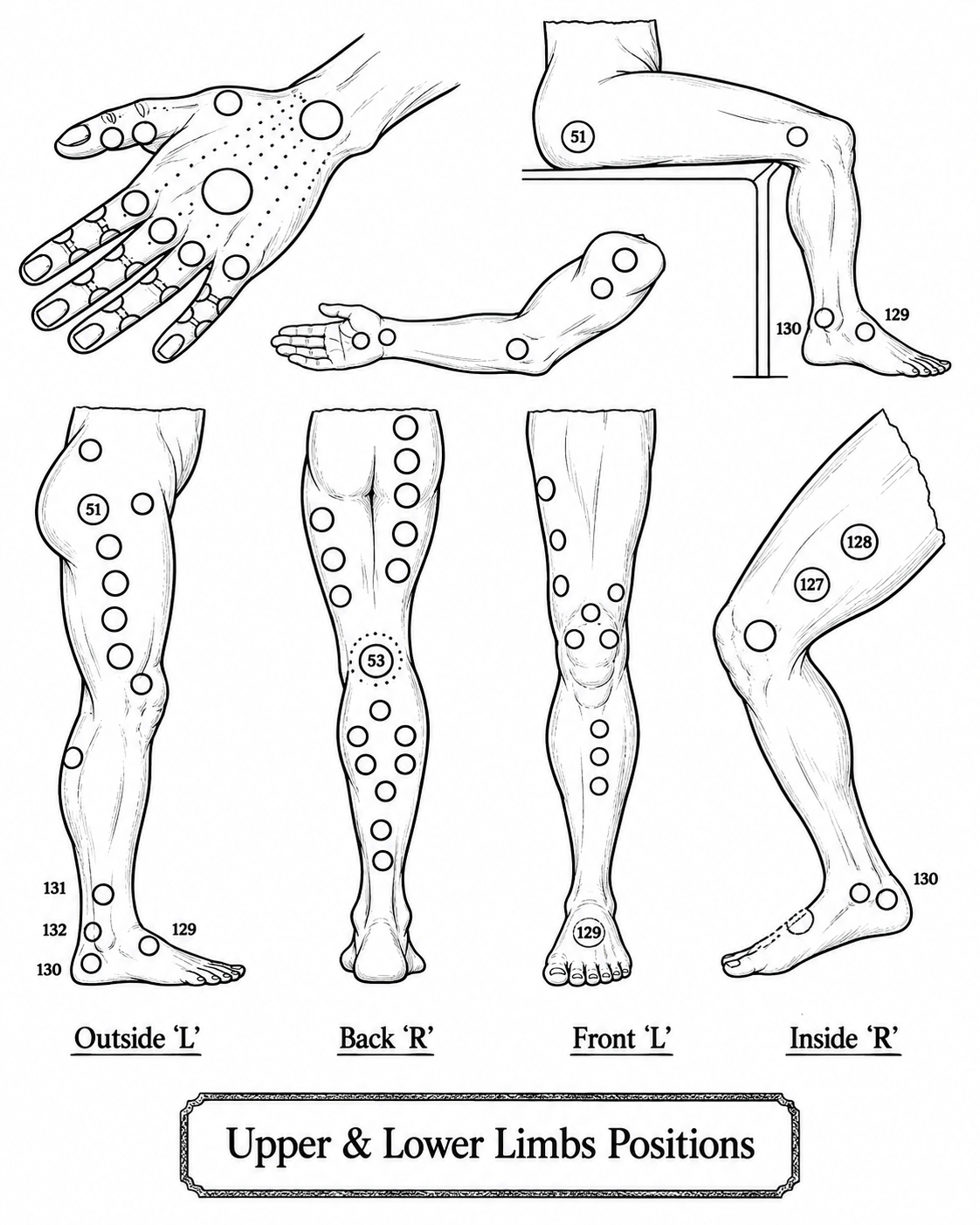
Upper and lower limb Hijama points chart with numbered traditional cupping locations
51–52
Outer Thigh / Femur Region Located on both sides of the thighs along the femur region.
53–54
Posterior Knee Region Located around the inner posterior part of the knee.
127–128
Inner Thigh Region Located on the medial aspect of the thighs.
129
Foot / Ankle Region Located around the upper and posterior foot region shown on the chart.
130
Heel / Ankle Sides Located on the inner and outer sides of the heel and ankle. Traditionally associated with swelling or oedema-related complaints.
131
Outer Lower Leg Above Heel Located approximately 5 cm above the heel on the outer side.
132
Outer Ankle / Lower Leg Region Located around the lower outer leg and ankle region. Traditional charts may associate this location with varicocele-related complaints; this is not established by the chart alone.
Clinical Note: These numbered locations come from traditional Hijama point charts. Associations with specific conditions do not prove that cupping at these sites diagnoses or treats those conditions. Point selection should consider anatomy, vascular structures, skin condition and individual clinical assessment.

Are Hijama Points the Same as Acupuncture Points?

Hijama points and acupuncture points are not exactly the same system. Some locations may overlap anatomically, but the two practices developed from different traditions and use different treatment methods.

Acupuncture uses specific point systems and meridian-based frameworks, while Hijama point selection may be based on anatomy, traditional practice, Sunnah-related sources, local symptoms and individual assessment.

A Hijama practitioner should therefore not assume that every acupuncture point is automatically a Hijama point, or that cupping at an acupuncture location produces the same effect as needle stimulation.

Key Point

Some Hijama and acupuncture locations may overlap, but the two point systems and treatment methods should not be treated as identical.

Are There Specific Sunnah Hijama Points?

Some Hijama locations are commonly associated with Prophetic practice in traditional Islamic sources. However, not every point used in modern Hijama charts should automatically be described as a Sunnah point.

The evidence for individual Sunnah-related points should be reviewed separately according to the relevant narrations and their authenticity.

Can One Hijama Point Treat a Specific Disease?

Traditional Hijama charts sometimes associate individual points with specific organs, symptoms or conditions. However, a point’s location on a chart does not by itself prove that cupping at that site can diagnose, treat or cure a particular disease.

Clinical outcomes depend on many factors, including the condition being treated, individual health status, treatment technique, point selection, number of sessions and the quality of available evidence.

For this reason, Hijama points are better understood as treatment locations that may be selected within a broader assessment rather than as fixed “disease points.”

Key Point

A Hijama point should not be described as a guaranteed treatment for a specific disease unless there is condition-specific clinical evidence supporting that claim.

Common Condition-Related Hijama Point Searches

Traditional Hijama charts are often searched in relation to specific health concerns. These terms reflect common point-chart searches and traditional associations, not clinically validated treatment protocols.

01
Hijama Points for Asthma Traditional charts may associate selected chest and upper-back locations with respiratory complaints. These associations should not be interpreted as established asthma treatment protocols.
02
Hijama Points for Eyesight Some traditional charts identify head or facial locations in relation to visual complaints. Their presence on a chart does not establish that cupping improves eyesight or treats eye disease.
03
Hijama Points for Erectile Dysfunction Traditional point maps may associate selected lower-body or pelvic regions with sexual health concerns. These chart associations are not evidence of a clinically proven treatment for erectile dysfunction.
04
Hijama Points for Depression & Anxiety Some traditional Hijama systems associate head, neck or upper-back locations with emotional or stress-related complaints. Condition-specific clinical evidence should be reviewed separately.
05
Hijama Points for Skin Allergy Traditional charts may connect selected body locations with skin complaints or allergic symptoms. These associations do not establish that cupping treats the underlying allergy.
Evidence Note: These condition-related terms are included as traditional atlas references and common search topics. A point appearing on a traditional chart does not establish that cupping at that location can diagnose or treat the related condition. Condition-specific claims require separate clinical evidence and safety review.

Safety and Areas to Avoid When Selecting Hijama Points

Not every body area is appropriate for Hijama. Point selection should take into account anatomy, skin condition, blood vessels, nerves, underlying medical conditions and the type of cupping being performed.

Extra caution is required around areas with prominent veins or arteries, damaged or infected skin, recent wounds, fractures, severe swelling, and regions where important nerves or other sensitive structures lie close to the surface.

Wet cupping should only be performed using appropriate infection-control procedures, sterile single-use equipment and proper clinical assessment.

!
Infected, inflamed or damaged skin
!
Open wounds or recent surgical sites
!
Prominent varicose veins or major superficial blood vessels
!
Areas of significant swelling or unexplained masses
!
Fractures or acute traumatic injuries
!
Highly sensitive anatomical regions where deeper structures may be at risk
!
Any site considered unsuitable after individual assessment
Safety Note: A point shown on a Hijama chart should never override anatomical safety or individual clinical assessment.

Summary

Hijama points are body locations used in traditional and clinical cupping practice, but there is no single universal point map that applies to every person or condition.

Point selection may be influenced by anatomy, symptoms, treatment goals, traditional Hijama charts, Sunnah-related sources and individual clinical assessment.

Charts can help identify common locations, but they should not be interpreted as proof that a specific point diagnoses, treats or cures a particular disease.

Safe Hijama practice should always prioritize anatomy, infection control, appropriate technique and individual assessment.

SCIENTIFIC REFERENCES

References

01

National Center for Complementary and Integrative Health (NCCIH).
Cupping.

A useful reference for general information on cupping, potential risks, side effects and infection-control considerations.

02

Al-Bedah AMN, et al.

Cupping Therapy. StatPearls, National Center for Biotechnology Information.
Provides clinical information on cupping practice, contraindications, precautions and possible complications.

03

Choi TY, et al.
Evidence Map of Cupping Therapy. Journal of Clinical Medicine. 2021;10(8):1750.

Reviews the available evidence for cupping across different health conditions and highlights variation in the quality of evidence.

04

Update evidence of effectiveness on pain relieving of cupping therapy: a systematic review and meta-analysis of randomized controlled trials.

A systematic review evaluating cupping for pain-related outcomes and the quality of available clinical evidence.

Important Note

The numbered locations shown in this atlas are derived from traditional Hijama point charts. The scientific references above support the general discussion of cupping, safety and clinical evidence; they do not independently validate each numbered point or its traditional condition-specific association.

screenshot 2026 10 01 160747

Written by

Dr Amr Salama, DPT

DPT, Cairo University • Licensed Physiotherapist in Dubai • MOHAP-Licensed Hijama Practitioner

Dr Amr Salama writes and reviews evidence-informed educational content on Hijama, cupping therapy, rehabilitation and related health topics.

Last reviewed
October 2026